
Operating experience
Building a partner-led route to market for enterprise AI in Southern Europe
Turning local distributors and adjacent industry partners into a scalable commercial channel for highly localised manufacturing markets.
- Company
- Enterprise AI software
- Expansion challenge
- Highly localised Southern European manufacturing markets were difficult to penetrate efficiently from the United Kingdom.
- Commercial unlock
- Build a partner-led distribution model around local software vendors, solution providers and machinery distributors that already had trusted access to the ideal customer profile.

The expansion challenge
Ameba had demonstrated that global brands and manufacturers would buy its enterprise AI software.
The company built an enterprise commercial engine from zero and won customers including Gymshark, America Today, Sport City International, Anglotex and Becri Group, with individual contracts typically in the approximately $50k–$150k ACV range.
But expansion into Southern Europe exposed a different challenge.
The garment-manufacturing ecosystem was fragmented, highly local and built around longstanding regional commercial relationships.
Penetrating these markets efficiently from the United Kingdom was difficult without local credibility, language, relationships and customer access.
The strategic question became:
- How do we gain trusted local access without rebuilding a full direct-sales organisation in every country?
The commercial unlock
The route to market was redesigned around local partners.
Rather than treating international expansion purely as a direct-sales problem, the company looked for organisations that already served the manufacturers Ameba wanted to reach.
The most interesting partners were not always traditional software resellers.
Textile-machinery and cutting-machine distributors already had deep relationships with garment manufacturers and a detailed understanding of their production environments.
Many were also looking for opportunities to expand their offering from physical machinery into software and digital solutions.
Ameba’s software did not compete with their existing products.
It complemented them.
That created value on both sides:
Ameba gained trusted local access to the right customers.
The distributor gained a software proposition it could introduce into its existing customer base.
How we operationalised it
A partner strategy only works when the company itself becomes distributable.
The organisation therefore built the infrastructure required to make carrying Ameba attractive and manageable for local partners.
This included:
- structured onboarding materials
- product and sales training
- partner enablement processes
- clear commercial hand-offs
- technical-sales support
- internal processes capable of supporting a growing partner network
The international commercial organisation was also redesigned.
A dedicated international-expansion manager was hired whose primary role was not direct customer acquisition.
The manager was responsible for identifying distributors, establishing and managing local relationships, enabling partners commercially and supporting technical sales conversations as opportunities progressed.
The machinery distributor brought the trusted customer relationship.
Ameba brought the software and technical-sales capability.
Together, they could enter accounts with considerably more credibility than a remote salesperson approaching the same manufacturer from the United Kingdom.
The expansion model therefore shifted from:
one sales team repeatedly entering new countries
to:
a central capability enabling multiple local routes to market.
The outcome
Alongside its international expansion, Ameba built its enterprise GTM from zero to approximately $500k in signed / active annual contract value and around $850k in late-stage pipeline within roughly 18 months.
The company grew to a 17-person organisation with teams across product, engineering, sales and marketing serving international brands and manufacturers.
We personally raised approximately $7.1M to accelerate the build-out of the product, team and global commercial organisation.
The more important internationalisation outcome, however, was the development of a partner-led model that could generate local market access without requiring Ameba to recreate a complete direct-sales organisation in every geography.
External validation
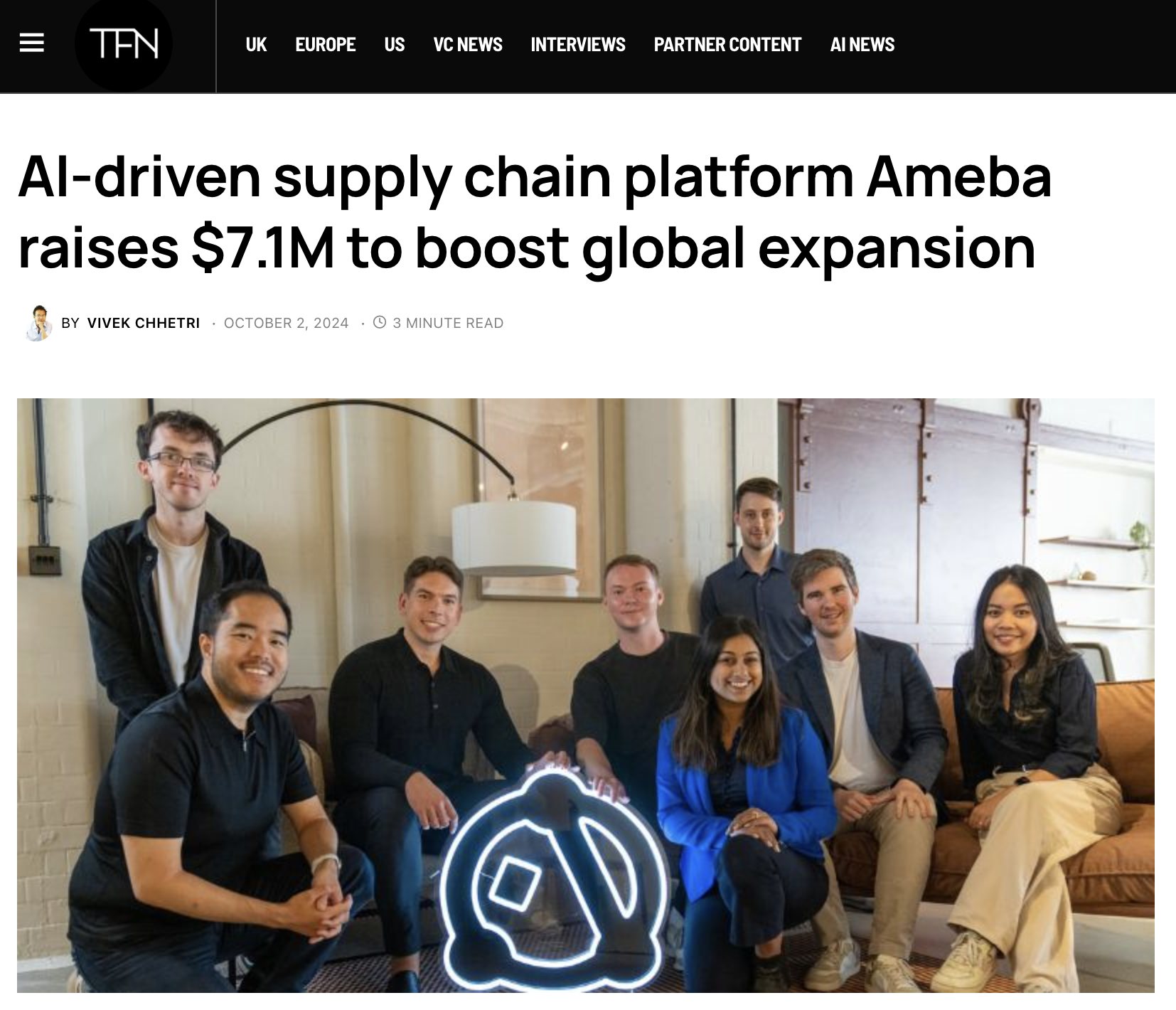
What this demonstrates
The fastest route into a new market is not always another salesperson.
Sometimes the commercial unlock is to identify the organisations that already possess the customer relationships you need and create a model that makes carrying your product attractive to them.
The strategic questions become:
- Who already serves our ideal customer?
- What do they sell today?
- Does our product complement rather than threaten their existing offering?
- Why should they distribute it?
- What capabilities must we build internally so they can succeed?
Ameba demonstrated that international expansion can require changing the route to market itself rather than simply exporting an existing direct-sales model.
That principle — building capabilities and networks around an existing team rather than assuming everything must be created internally — is central to PHOIA’s approach to global expansion today.
This case reflects operating experience prior to PHOIA and forms part of the track record behind the firm.